Best Workouts for Strengthening Your Biceps: Build Powerful, Defined Arms

Well-developed biceps are often considered the hallmark of a strong, fit physique. Beyond aesthetics, strong biceps are essential for pulling movements, carrying objects, and countless daily activities. Whether you’re looking to increase arm strength, improve athletic performance, or build impressive muscle definition, understanding the most effective biceps exercises and training principles will help you achieve your goals faster and more efficiently.
Understanding Biceps Anatomy and Function
The biceps brachii consists of two heads: the long head and short head. The long head runs along the outer portion of your arm and creates the biceps peak, while the short head sits on the inner portion and contributes to overall arm thickness. Beneath the biceps lies the brachialis, a muscle that adds substantial mass to your upper arm and contributes significantly to elbow flexion strength.
The biceps’ primary functions include elbow flexion (bending your arm) and forearm supination (rotating your palm upward). Effective biceps training incorporates exercises that emphasize both functions while targeting the different muscle heads from various angles. Understanding this anatomy helps you select exercises that build complete, balanced arm development.
Essential Compound Exercises for Biceps Strength
Barbell Curls
The barbell curl is the foundation of biceps training, allowing you to lift the heaviest weights and stimulate maximum muscle growth. Stand with feet shoulder-width apart, grip a barbell with an underhand grip at shoulder width, and curl the weight upward while keeping your elbows stationary at your sides. Lower the weight under control. The barbell’s fixed hand position maximizes load and builds overall biceps mass effectively.
Chin-Ups
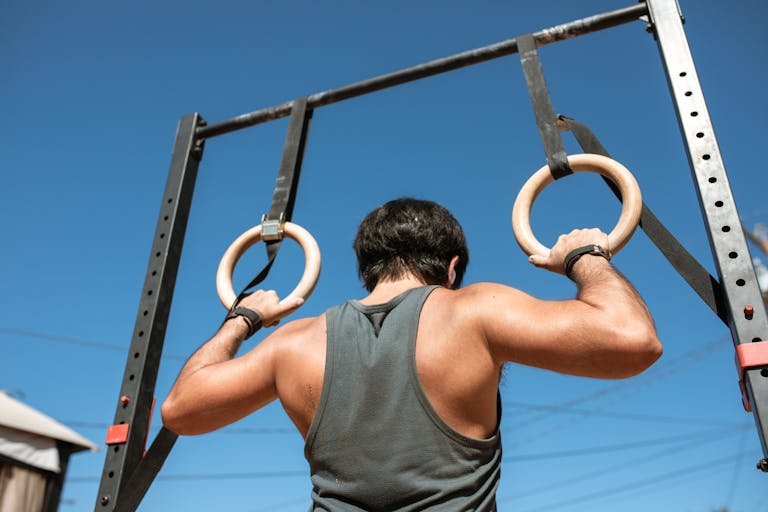
Often overlooked for biceps development, chin-ups with an underhand grip are one of the most effective exercises for building arm strength and size. Hang from a pull-up bar with palms facing you, then pull your body upward until your chin clears the bar. This compound movement works your biceps, back, and core simultaneously while building functional pulling strength. If bodyweight chin-ups are too challenging initially, use resistance bands or an assisted pull-up machine.
Hammer Curls
Hold dumbbells at your sides with palms facing each other in a neutral grip. Curl the weights upward while maintaining this hand position throughout the movement. Hammer curls uniquely target the brachialis and brachioradialis muscles along with the biceps, building arm thickness and grip strength. This variation is essential for complete arm development and helps prevent overuse injuries by varying movement patterns.
Isolation Exercises for Maximum Biceps Development
Dumbbell Biceps Curls
Dumbbells allow for independent arm movement and greater range of motion compared to barbells. Stand or sit holding dumbbells at your sides with palms facing forward. Curl one or both weights upward, rotating your wrist slightly at the top to maximize the supination component. The freedom of movement helps correct strength imbalances between arms and allows for deeper muscle contraction.
Preacher Curls
Using a preacher bench or incline bench, position your upper arms on the pad with arms extended. Curl the weight upward while keeping your upper arms firmly against the pad. This position eliminates momentum and isolates the biceps completely, particularly emphasizing the lower portion of the muscle. Preacher curls are excellent for building the biceps peak and improving the mind-muscle connection.
Incline Dumbbell Curls
Sit on an incline bench set to 45-60 degrees with arms hanging straight down. Curl the dumbbells upward while keeping your elbows back and stationary. This stretched position places maximum tension on the long head of the biceps, contributing to peak development. The incline angle prevents you from using momentum, ensuring strict form and maximum muscle engagement.
Concentration Curls
Sit on a bench with legs spread, rest your elbow against your inner thigh, and curl a dumbbell upward with deliberate control. This isolated position allows you to focus intensely on the working biceps with zero assistance from other muscles. Concentration curls are perfect for finishing your biceps workout and achieving a powerful muscle pump.
Cable Curls
Using a cable machine with a straight bar or rope attachment, perform curls with constant tension throughout the entire range of motion. Cables provide resistance that doesn’t diminish at the top of the movement like free weights do, keeping your biceps under continuous tension. Try different attachments and angles to vary the stimulus and target your biceps from multiple positions.
Designing Your Biceps Training Program
Train biceps 2-3 times per week with at least 48 hours recovery between sessions. Since biceps are involved in all back training, consider scheduling arm-specific workouts after rest days for optimal recovery. Begin with compound movements like barbell curls or chin-ups (3-4 sets of 6-10 reps), then progress to isolation exercises like preacher curls and hammer curls (3 sets of 10-15 reps each).
Progressive overload remains crucial for continued growth. Gradually increase weight, repetitions, or sets while maintaining strict form. Focus on controlled eccentric (lowering) phases, which cause significant muscle damage that stimulates growth. Vary your grip width, hand position, and exercise selection every few weeks to prevent adaptation and plateaus.
Common Mistakes and Form Tips
Avoid swinging your body or using momentum to lift heavier weights—this reduces biceps activation and increases injury risk. Keep your elbows stationary throughout curling movements. Control the weight throughout the full range of motion rather than using partial reps. Squeeze your biceps at the top of each repetition for maximum contraction.
Don’t overtrain your biceps, as they’re relatively small muscles that recover more slowly than you might expect. Quality trumps quantity—8-12 total working sets per week is sufficient for most people.
Conclusion
Building strong, well-developed biceps requires strategic exercise selection, proper form, and consistent progressive overload. By incorporating these compound and isolation movements into your training routine and following sound programming principles, you’ll develop the arm strength and size you’re pursuing. Combine your training with adequate protein intake, sufficient calories for growth, and proper recovery for optimal results.